
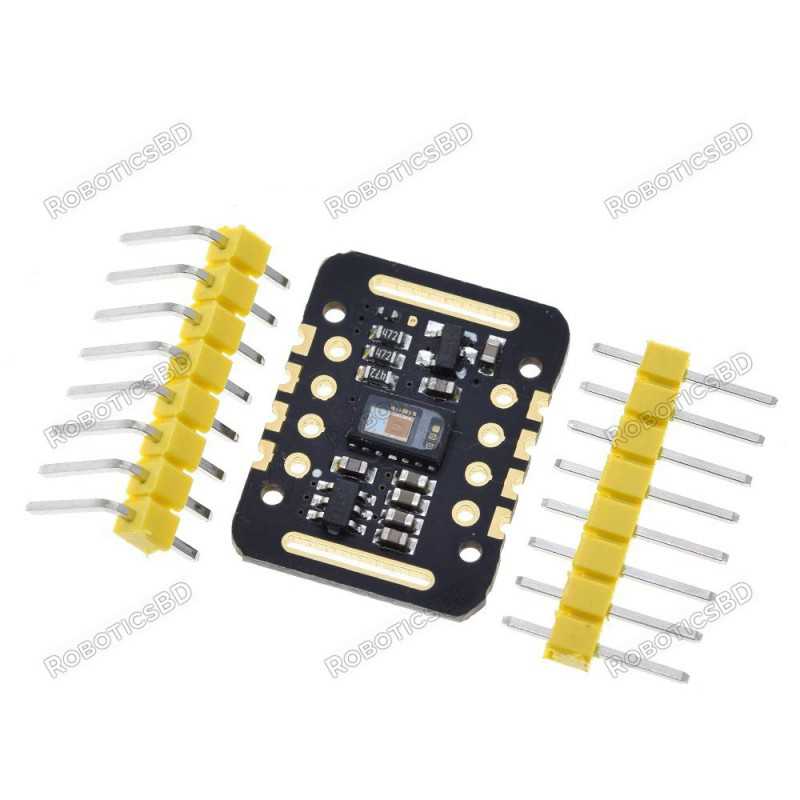
Description
The MAX30102 Heart Rate & Pulse Oximeter Sensor Module is a compact optical biosensor designed for heart-rate (pulse) and SpO₂ monitoring applications. It integrates red and infrared LEDs, a photodetector, ambient-light cancellation, and low-noise signal-processing circuitry into a single sensor solution. Communication with a microcontroller is through an I²C-compatible digital interface.
The module is ideal for Arduino, ESP32, ESP8266, Raspberry Pi, wearable devices, fitness projects, IoT systems, and health-monitoring prototypes.
Key Features
MAX30102 integrated heart-rate and pulse-oximetry sensor
Measures heart-rate/pulse signals
Supports SpO₂ measurement applications
Integrated red and infrared LEDs
Integrated photodetector
Ambient-light cancellation
High signal-to-noise ratio
Digital I²C interface
Programmable LED current
Programmable sample rate
Built-in 32-sample FIFO
Low-power operation
Compact size suitable for wearable projects
Software-controlled shutdown mode
Technical Specifications
Parameter Specification
Sensor IC MAX30102
Sensor Type Optical Heart-Rate & Pulse-Oximeter Sensor
Measurement Heart Rate / Pulse / SpO₂*
Interface I²C
Communication Voltage 1.8V logic
Sensor Supply 1.8V
LED Supply 3.3V
LED Type Red & Infrared
Red LED Wavelength Approx. 660 nm
IR LED Wavelength Approx. 880 nm
ADC Resolution 18-bit
Sample Rate 50–3200 samples/second
LED Current Programmable, up to 50 mA
FIFO 32-sample FIFO
Shutdown Current Approx. 0.7 µA typical
Operating Temperature -40°C to +85°C
Interface Pins SDA, SCL, INT, VCC, GND
The IC supports programmable sampling and LED-current settings, while the exact power pins and voltage handling of a breakout module can vary by board design.
Pin Configuration
Typical MAX30102 modules include:
VIN / VCC – Power input
GND – Ground
SDA – I²C data
SCL – I²C clock
INT – Interrupt output
Note: Pin labels and onboard regulator/level-shifter arrangements can vary between different MAX30102 breakout boards.
Applications
Heart-rate monitoring projects
Pulse monitoring systems
SpO₂ monitoring prototypes
Fitness and health-monitoring devices
Smartwatch and wearable projects
Arduino health projects
ESP32 IoT health projects
Raspberry Pi biometric projects
Patient-monitoring prototypes
Fitness trackers
IoT healthcare systems
Biomedical and educational projects
Compatible Platforms
The MAX30102 can be integrated with many systems that support I²C communication, including:
Arduino
ESP32
ESP8266
Raspberry Pi
STM32
Other I²C-compatible microcontrollers
Advantages
Small and compact sensor solution
Integrated optical components
Low-power operation
Digital I²C communication
Programmable measurement parameters
Suitable for wearable and battery-powered applications
Reduces the need for external optical components
Important Note
SpO₂ and heart-rate values obtained from hobby/development modules should not be considered medical-grade measurements or used for medical diagnosis. Measurement quality can be affected by finger placement, movement, ambient light, skin characteristics, sensor positioning, and software algorithms. The MAX30102 is intended as a sensor component for development and monitoring applications


Reviews
There are no reviews yet.